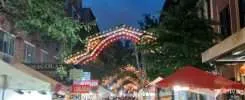
I was walking down West 23rd Street on a warm summer night when the Hotel Chelsea’s neon sign stopped me cold. “HOTEL” stacked vertically in white, “CHELSEA” blazing red below it. The whole thing burning against a deep blue sky while people spilled out onto the sidewalk below. I raised my camera. That’s what documentary photography does to me. Some signs demand to be photographed. This one has been demanding it for over 140 years. Hotel Chelsea NYC history is worth discovering.
A neighborhood built on a poet’s blueprint
To understand the Hotel Chelsea, you first need to understand Chelsea itself — because the neighborhood made the hotel possible. The name traces back to Captain Thomas Clarke, a retired British officer who, in 1750, purchased a tract of farmland in Manhattan and named it “Chelsea” after the Royal Hospital Chelsea in London, a home for retired soldiers. His estate eventually passed to his grandson, the poet and scholar Clement Clarke Moore — the man who wrote “A Visit from St. Nicholas” — who donated much of the family land to the Episcopal Church and laid out blocks of refined Greek Revival townhouses, creating one of Manhattan’s earliest planned residential communities.

Throughout the 19th century, the laying of the Hudson River Railroad tracks in 1847 transformed Chelsea, filling it with warehouses, lumberyards, and industry. By the late 1800s, 23rd Street had become New York’s theater district — and it was into that creative, chaotic energy that the Hotel Chelsea was born. In the 20th century, Chelsea evolved into a haven for artists, LGBTQ+ communities, and creative professionals — a transformation the hotel both reflected and accelerated.
The hotel that refused to follow any rules
Constructed in 1883 when New York’s theater district was centered around 23rd Street, the Victorian Gothic building was initially one of the city’s first cooperative apartment buildings — a utopian experiment in shared living — before reopening as a luxury hotel in 1905. Until 1899, it was actually the tallest building in New York City.
What happened next is the stuff of cultural legend. The Chelsea became home to writers, musicians, artists, and actors including Bob Dylan, Charles Bukowski, Janis Joplin, Patti Smith, Leonard Cohen, Arthur C. Clarke, Dylan Thomas, Sid Vicious, and Robert Mapplethorpe — along with multiple figures associated with Andy Warhol’s Factory. Arthur C. Clarke wrote 2001: A Space Odyssey while living at the Chelsea. Dylan Thomas died there of alcohol poisoning. Bob Dylan noted in a 1985 interview that he and his wife lived in the Chelsea Hotel on the third floor in 1965 or ’66, when their first baby was born. Leonard Cohen wrote “Chelsea Hotel #2” about a brief encounter with fellow resident Janis Joplin.
What struck me standing in front of the hotel that night wasn’t just the neon — it was the energy on the sidewalk. People gathered under the canopy of tropical plants by the entrance, the street stretching east behind them toward the city’s glow. The same scene has probably played out on this exact sidewalk every night for a hundred years, just with different people. That’s what makes the Chelsea a documentary photographer’s dream. The building is the constant Hotel Chelsea NYC history. The city changes around it.
Hotel Chelsea NYC history – How to get there by subway
🚇 Getting to the Hotel Chelsea — 222 West 23rd Street
Take the 1 train to 23rd Street Exit at 23rd St on the 1/2/3 line (Seventh Avenue). Walk one block west on 23rd Street — the hotel is right there between Seventh and Eighth Avenues. Takes under 2 minutes from the exit.
C or E train to 23rd Street Exit at 23rd St on the C/E line (Eighth Avenue). Walk one block east on 23rd Street. Ideal if you’re coming from the West Village, Hell’s Kitchen, or Port Authority.
F or M train to 23rd Street Exit at 23rd St on the F/M line (Sixth Avenue). Walk three blocks west on 23rd Street. Good option if you’re coming from Brooklyn via the F train.
Subway fare: $3 per ride with tap-to-pay. The hotel is at 222 West 23rd Street, between Seventh and Eighth Avenues, Manhattan.
Why Hotel Chelsea NYC history is still worth a long walk
Once you visit the hotel, don’t rush back to Midtown. Chelsea rewards walkers who pay attention. The High Line — an elevated park built on a former freight rail line — runs through the neighborhood and offers one of the best documentary photography routes in the entire city, with views of the Hudson, West Chelsea’s gallery district, and the skyline shifting behind you as you walk north. The neighborhood’s gallery row on West 20th through 26th Streets houses some of the most significant contemporary art spaces in the world, most of them free to enter.
Furthermore, if you walk south toward 14th Street you hit the Meatpacking District, and if you walk north you reach Hudson Yards — two neighborhoods that show you exactly how fast New York City reinvents itself. The Chelsea Hotel has watched all of it from the same address on 23rd Street since 1883. That neon sign has been glowing through every version of this city. When I photograph it at night, that’s what I’m trying to capture — not just a building, but a fixed point in a city that never stops moving.